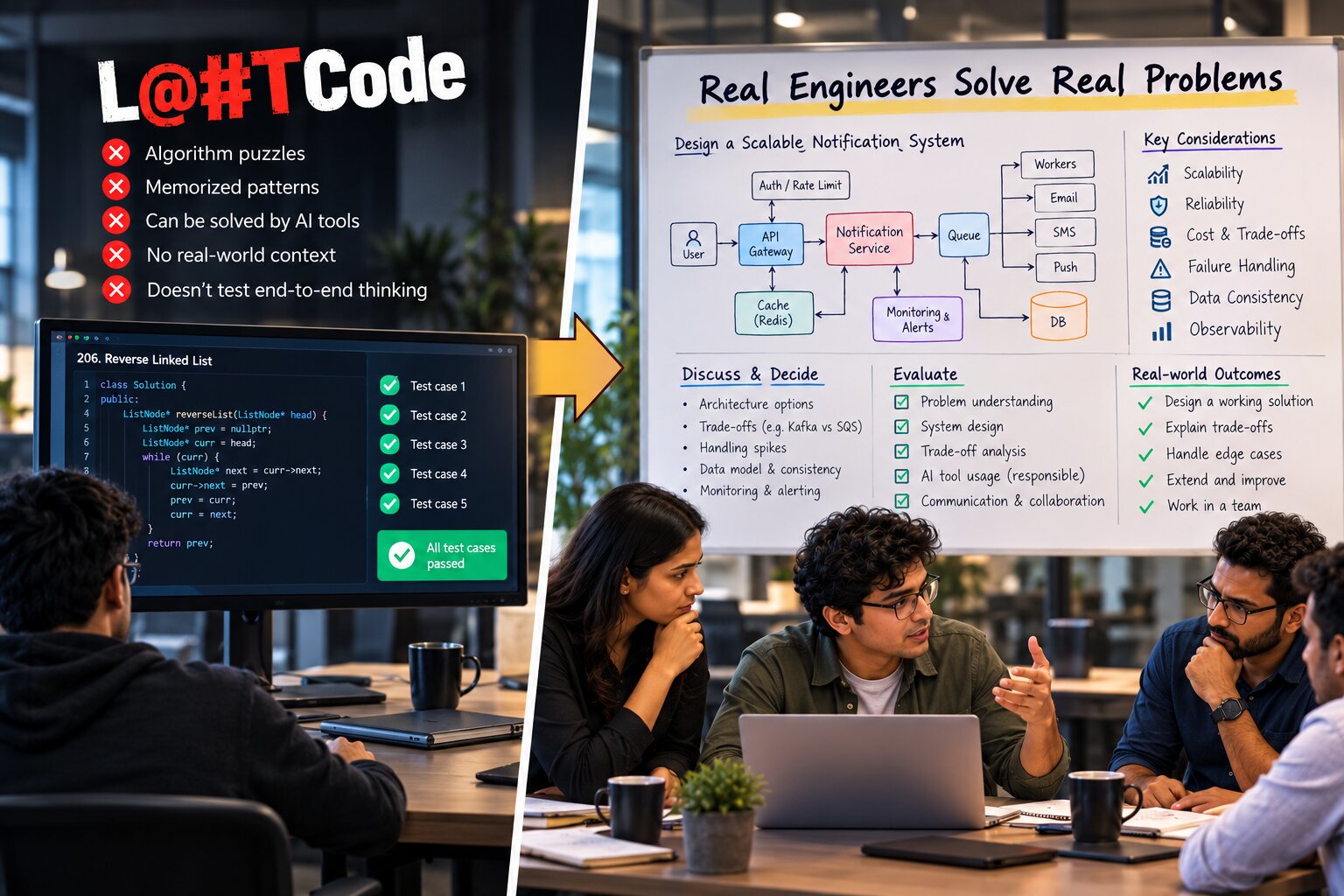
The candidate scored 100%. Every test case green, inside twenty minutes. Three weeks after joining, the same engineer shipped a feature nobody asked for, picked a database the team could not run, and merged AI-generated code that double-booked customers.
The coding test was not wrong. It was measuring the wrong thing. Reversing a linked list says nothing about whether someone can scope an MVP, choose a sensible stack, or notice that the co-pilot’s suggestion is subtly broken.
“Every candidate can now produce code. Very few can decide which code is worth writing.”
What changed
Engineering teams now work with AI co-pilots every day. Hiring managers increasingly tell us the same thing: they want people who understand systems, make trade-offs under real constraints and use AI responsibly — not people who memorised puzzle patterns. A standalone algorithm round is also the easiest round for an assistant tool to answer for the candidate.
Old coding test vs. ThinkStack
| Classic coding test | ThinkStack | |
|---|---|---|
| What is tested | Recall of one algorithm in isolation | Judgment across a whole product: scope, stack, risk and code |
| AI assistants | Banned — or silently used | Part of the task; we see how the candidate steers and checks them |
| Constraints | None beyond a timer | Team size, deadline, cost and risk the candidate must balance |
| Reasoning | Hidden behind a pass/fail test case | Written down and scored, decision by decision |
| Report | A single score | A layered report on thinking, building and trade-offs |
Scope like a product engineer
Pick the MVP features that fit a 3-engineer, 3-week plan — and rank them by priority.
Choose the stack per layer
Select technologies for each layer and see the effect on speed, complexity, cost and risk.
Build with an AI co-pilot
Write and fix real code with AI help. Accepting a wrong suggestion is as telling as writing a right one.
Defend the trade-offs
Explain each decision in plain words, against the deadline and team constraints.
AI is allowed. That is the point.
Banning AI in a coding test creates a test of a job that no longer exists. ThinkStack lets candidates work with a co-pilot and watches how they use it: do they give it clear context, read what it returns, catch the edge case it missed, and keep their design intact? Blind copy-paste shows up in the report just as clearly as careful engineering.
A report you can actually decide with
Instead of one score, the hiring panel gets a layered view of how the candidate thinks and builds — with the written reasoning behind every choice, plus session recordings and integrity signals for review.
Sample report · illustrative values
Where it fits in the hiring journey
Add it as a workflow stage, after resume screening or a short assessment, with its own cutoff.
Match the scenario to the role, backend, full-stack or product engineering chapters.
Keep humans on the decision, the report sharpens the interview; it does not replace it.
The engineers you want next year will spend less time typing code and more time deciding what to build, with what, and why. Test that. ■
Book a ThinkStack demo