
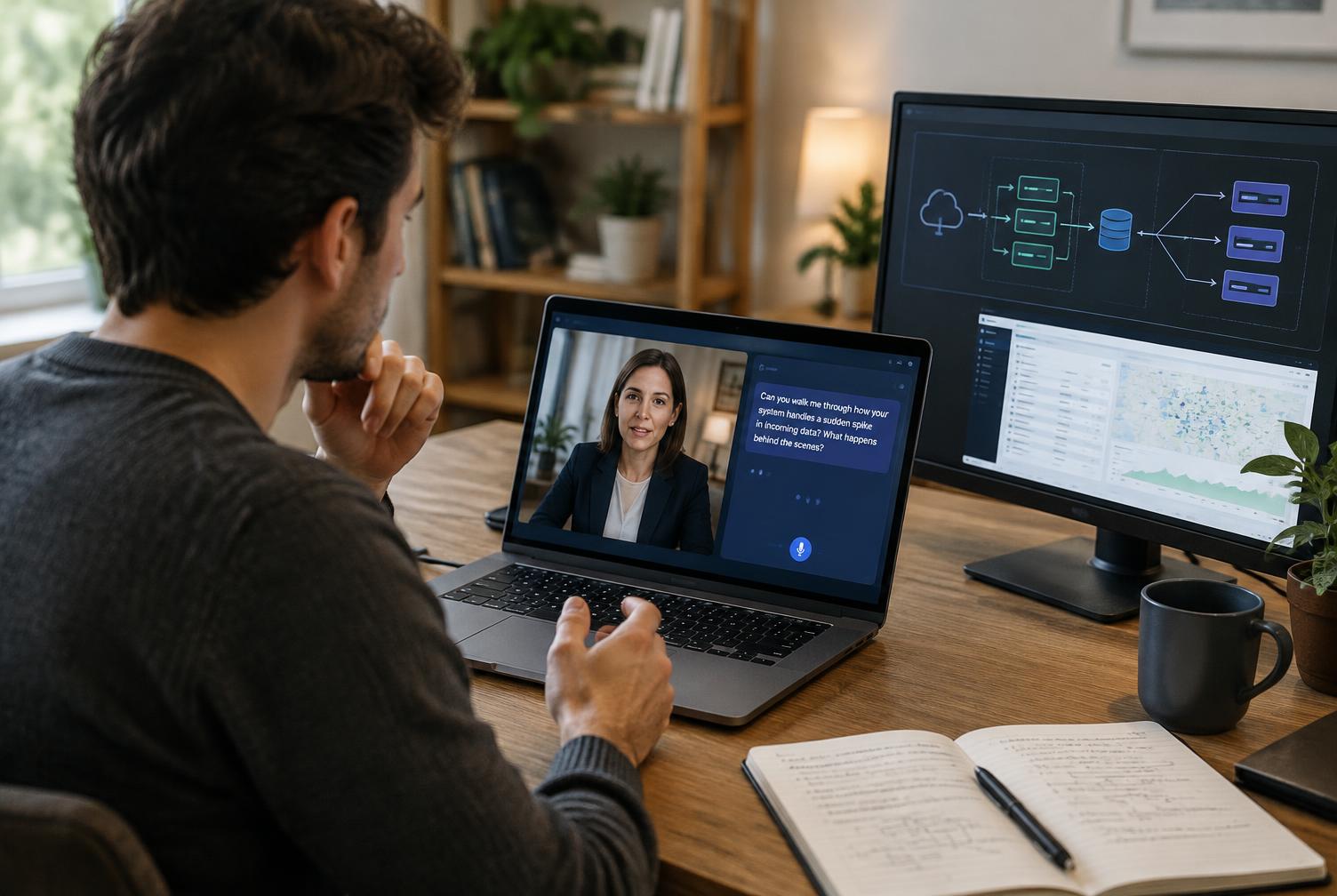
A candidate opens a laptop. The application is sleek. The workflow runs. The architecture diagram has all the right boxes. A year ago, that demonstration alone might have been convincing.
Today, capable AI tools can produce in days what once took a team weeks. That is useful progress — but it has weakened an old hiring signal. A large project no longer proves that the person presenting it made the key decisions, understands the system, or can own it after the demo ends.
The problem is not whether AI was used. Strong engineers use it too. The problem is knowing whether the candidate can explain the use case, trace the real flow, defend a trade-off, recognise a weak point, and adapt when the requirement changes.
“The proof is no longer the project. The proof is the conversation around it.”
Where a rehearsed demo runs out
A conventional project review usually asks the same broad questions: What did you build? Which technologies did you use? What was challenging? Those answers can be prepared, memorised, or generated before the call.
Real understanding becomes visible when the question is tied to something that happened seconds ago on the candidate’s own screen.
Internals
“What happens inside the system after the user triggers that flow?”
Trade-off
“Why did you choose this design rather than the simpler alternative?”
Failure
“What breaks first if usage grows ten times from here?”
Ownership
“What would you rebuild differently if you started again?”
A person who owns the work may pause, but can reason through these questions. Someone who only assembled the surface tends to retreat into generic language. The difference appears quickly — and it is much harder to rehearse.
The bot watches the work, then follows the evidence
AlphaRecrewt’s Presentation Analysis Bot turns that live demonstration into a structured assessment. It does not read from a fixed interview script. Its questions are grounded in what the candidate said and what was visible during the demo.
Set the context. The candidate briefly describes the project, the problem it solves, and what they will demonstrate.
Show the work. They share the real system and narrate what is happening. Screen evidence and spoken explanation are captured together.
Face the follow-up. The bot asks one short question at a time, grounded in the exact feature, flow, or decision the candidate just showed.
Explain it to others. Candidates who clear the technical gate can teach the project to different learner personas, revealing clarity and adaptability.
What the assessment can reveal
Genuine ownership
Whether the person can connect the visible product to the system underneath it.
Technical depth
How clearly they explain internals, architecture, dependencies, and data flow.
Judgement under pressure
Whether they can reason about trade-offs, debt, scale, change, and failure.
Explanation ability
Whether the answer is clear, direct, and adapted to the person listening.
Exhibit 1 · Illustrative presentation analysis
Decision
Bar raised
The candidate demonstrates clear ownership and can explain the system beyond the visible interface.
Evidence captured
Live demo · narration · grounded Q&A · session recording
Capability evidence
Strength
Traces the product flow clearly and names concrete design decisions.
Development area
Needs a stronger answer on recovery when a downstream service fails.
Reviewer evidence
Screen moments and the candidate’s own words remain available for review.
One standard, even across thousands
The value is not only a deeper interview. It is a repeatable one. Every candidate receives a structured demonstration, evidence-grounded probing, and the same capability framework. Reviewers can focus on the proof instead of trying to remember another hour-long call.
Project-based hiring. Verify that portfolio work reflects real understanding, not just a polished output.
Graduate and bootcamp reviews. Assess thousands of final projects against one consistent evidence standard.
Innovation challenges. Separate impressive demos from solutions whose creators can defend their choices.
Internal mobility. Find people who can both build and explain before moving them into ownership roles.
Partner and vendor validation. Confirm the team presenting a system can maintain, change, and hand it over.
That is the signal teams need now: not who can produce the biggest project, but who can open it, explain it, defend it, and keep it working after the presentation ends. ■
Talk to sales →