The answer arrives too cleanly. The candidate pauses for two seconds, then delivers a perfect definition, three numbered trade-offs and a polished recommendation. The interviewer sees steady video and a shared browser window. Nothing obvious looks wrong.
That is exactly the gap a new category of interview assistants is designed to occupy. Their public pitch is straightforward: listen to the interviewer, generate an answer in real time and keep the prompting layer private while the candidate shares another window.
“If the interview tests only what the microphone can hear, the microphone can become the answer key.”
Market watch · What real-time assistants publicly promise
Parakeet AI
Advertises real-time answers and describes the experience as “100% Undetectable.”
Final Round AI
Says its Interview Copilot listens during live interviews and privately streams suggested answers.
Interview Coder / Cluely
Markets interview assistance around hidden or “undetectable” use during coding rounds.
LockedIn AI
Promotes a hidden desktop copilot intended to stay out of normal screen-sharing views.
A general video meeting is doing its job when the people can see, hear and share a screen. It does not know whether the answer matches a diagram, whether another display sits outside the shared frame, or whether a fluent response collapses under one specific follow-up. That is not a Teams or Zoom failure. It is the difference between a meeting room and an interview evidence workspace.
Seen in the wild
The sales pitch is already on your candidate’s phone
Source: Techmetronix
Source: Final Round AI
Source: Interview Sidekick
The linked fourth Short cannot be embedded because its uploader disabled embedding. The examples illustrate the category’s marketing; they do not verify every product claim.
The answer is not another detector. It is a better interview.
Trying to guess which application is running can become an endless contest between hidden windows and new detection techniques. Interview Studio takes a different approach: create multiple, independent moments where the candidate must connect speech to visible reasoning, physical context and a live follow-up.
The response · Three independent opportunities to investigate
Make the problem visual
Push a role-specific diagram to the candidate, change a constraint, and ask them to trace or repair what they can see.
Look beyond the shared window
Add a side-positioned phone view of the candidate’s hands, laptop and nearby workspace—with consent.
Listen for scripted delivery
Use transcript-based delivery signals to prompt a sharper follow-up, never to make an automatic accusation.
Layer one: put the problem on screen
The interviewer generates or selects a role-appropriate architecture, flow, state, data-model or people-process diagram and pushes it into the candidate’s Diagram view. The candidate must trace what exists—not merely answer a generic prompt heard through the call.
Layer one · Move from polished speech to visible reasoning
Interviewer changes the problem
“The queue is delayed and traffic rises tenfold. Trace the failure. Now remove the cache.”
Point to the path. The answer must correspond to what is actually on screen.
Change a constraint. The candidate has to adapt, not merely finish a prepared paragraph.
Defend the trade-off. The interviewer can probe why, where and what fails next.
This does not make visual questions impossible for AI. Multimodal systems exist. It does make the interview less dependent on a single audio channel and gives the reviewer a clear surface for progressive questions: point to the first failure, change one node, defend the new trade-off.
Layer two: let the phone see what screen sharing cannot
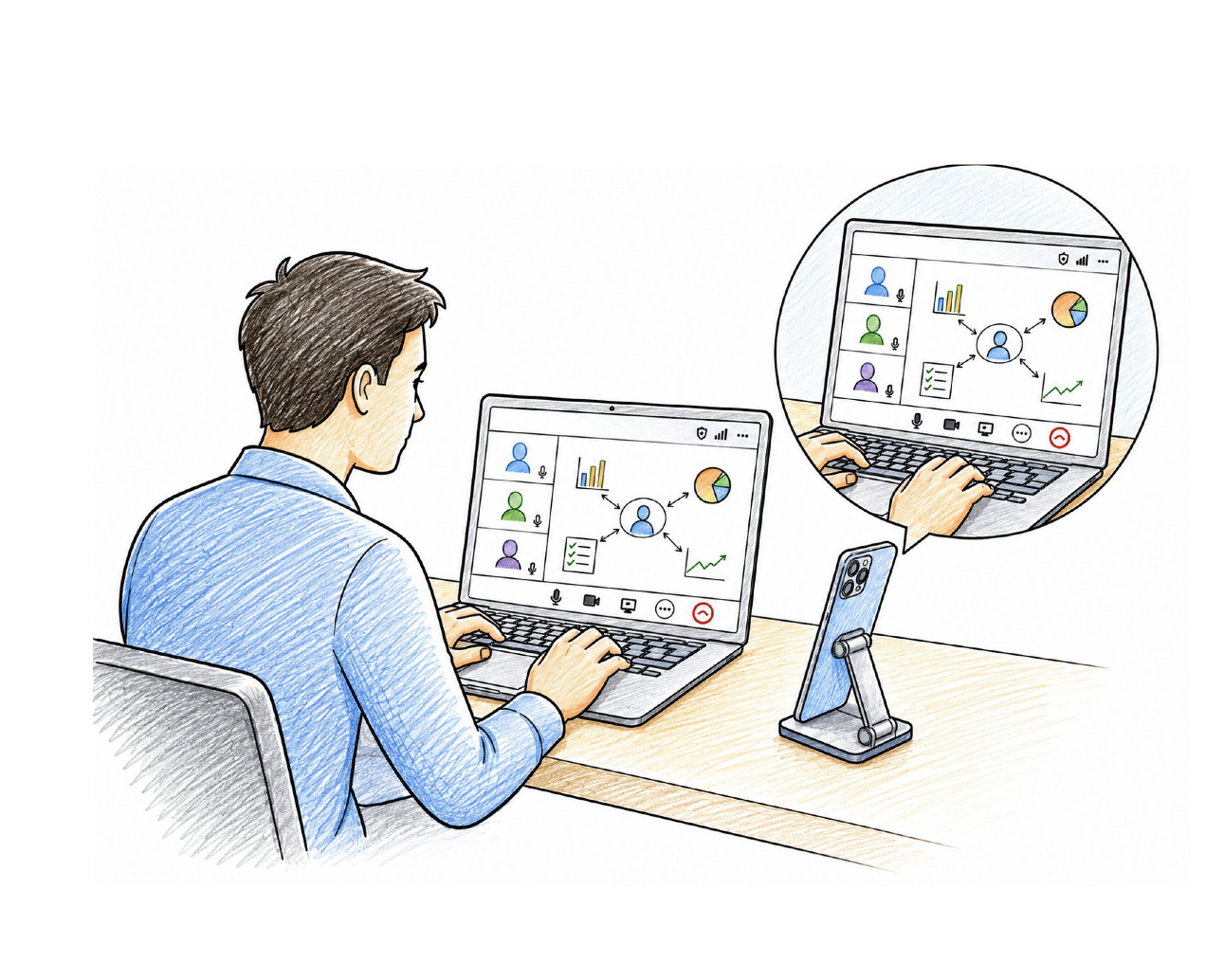
A candidate can share one window while another application sits elsewhere. Operating systems intentionally protect some windows and overlays from capture. Interview Studio’s optional 3rd Eye does not try to defeat operating-system privacy controls in software. With the candidate’s consent, a phone joins by QR code as a second, video-only camera.
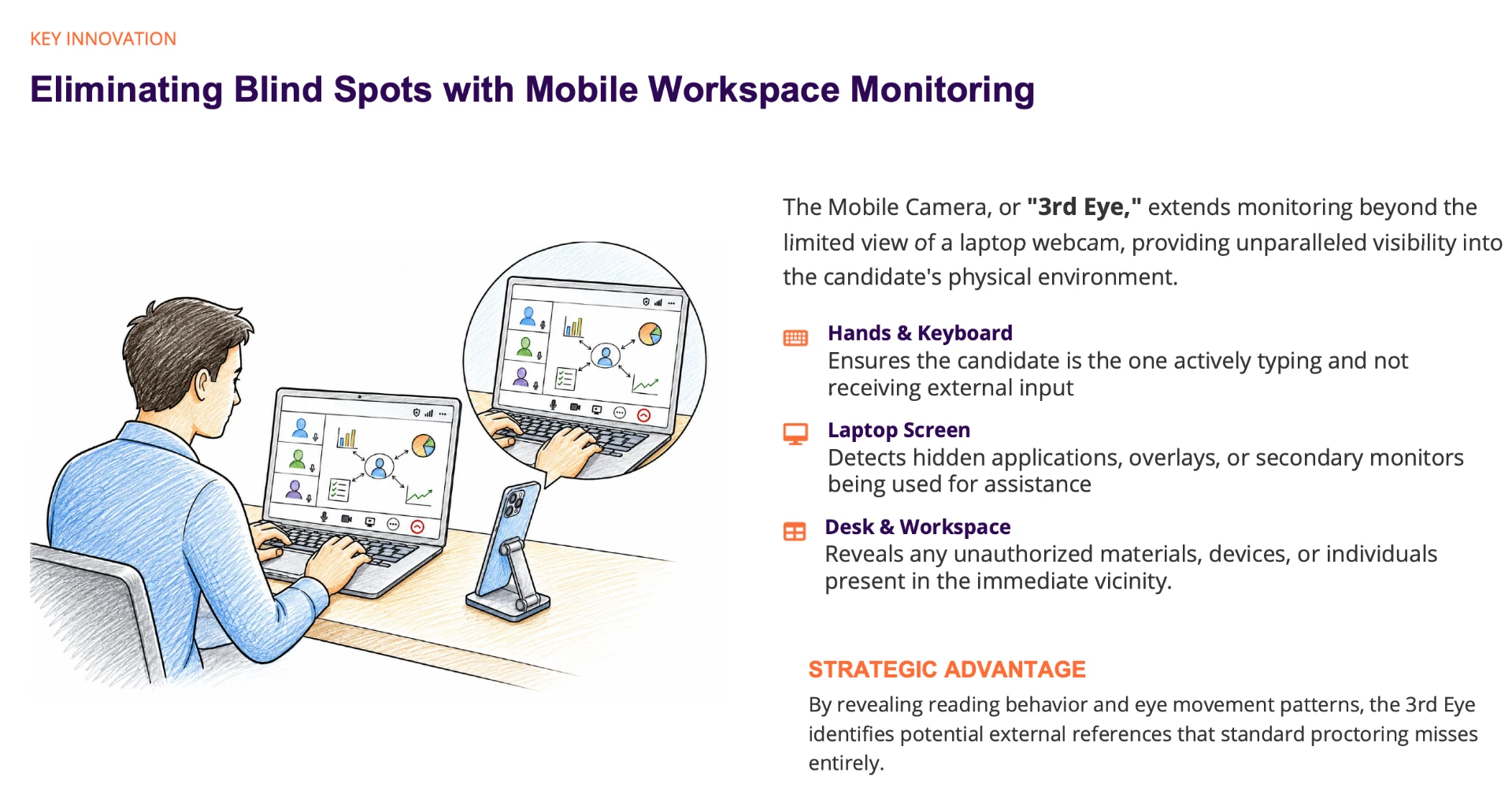
Placed to the side, the phone can show the candidate’s face, hands, laptop area and immediate workspace while the main laptop carries the interview. The interviewer decides whether something deserves a question. A second camera is context—not a verdict.
Face and attention
A wider view can help the interviewer understand where attention moves.
Laptop area
The reviewer can see more than the selected window being shared.
Nearby workspace
Hands, another device or another person may be visible in context.
Layer three: turn “that sounded robotic” into a fair probe
Interview Studio can send rolling transcript windows to the tenant’s configured AI provider. It looks for delivery patterns such as uniformly structured phrasing, definition dumps, little self-correction and unusually complete lists. The interviewer sees advisory naturalness, robotic-delivery and AI-likeness indicators with a suggested follow-up.
Layer three · From an alert to a better question
Highly structured phrasing
The answer uses uniform sentence lengths, a definition-first structure and little self-correction.
Recommended human probe
“You chose a queue for resilience. Tell me about one situation where that decision made the system worse.”
The candidate gets a fair chance to answer. The interviewer gets a concrete test of depth. The software does not decide whether the candidate cheated.
A nervous expert may sound rehearsed. A fluent communicator may speak in lists. Transcription may be imperfect. For those reasons, the signal must never reject a candidate or establish dishonesty. Its useful output is the next question.
A realistic interview: three minutes, three kinds of evidence
10:14
The polished answer
The candidate gives a textbook explanation of event-driven resilience. The transcript panel marks the delivery for a closer look.
10:15
The visual change
The interviewer pushes a diagram, removes the retry queue and asks the candidate to trace one failed order.
10:16
The independent probe
The candidate must point to the affected path, explain a past trade-off and respond while the side camera provides workspace context.
No one layer “catches” the candidate. The panel gets something more defensible: whether the explanation stays coherent when the visual changes, whether the candidate can connect it to lived experience, and whether the surrounding context raises a question worth documenting.
The non-negotiables
Tell candidates what is being monitored, and obtain appropriate consent before adding the phone view or analysis.
Offer a reasonable alternative, where accessibility, privacy, device availability or local rules require one.
Treat every alert as a prompt, not proof, a scorecard shortcut or an automatic rejection.
Record the human reasoning, including the follow-up asked and the candidate’s actual response.
General meeting tools remain useful places to meet. When the interview must withstand real-time prompting, AlphaRecrewt Interview Studio adds a visual task, a wider workspace view and a reasoned follow-up path around the conversation. The result is not a promise that deception becomes impossible. It is a much harder interview to pass with somebody else’s words alone. ■
See the three layers