
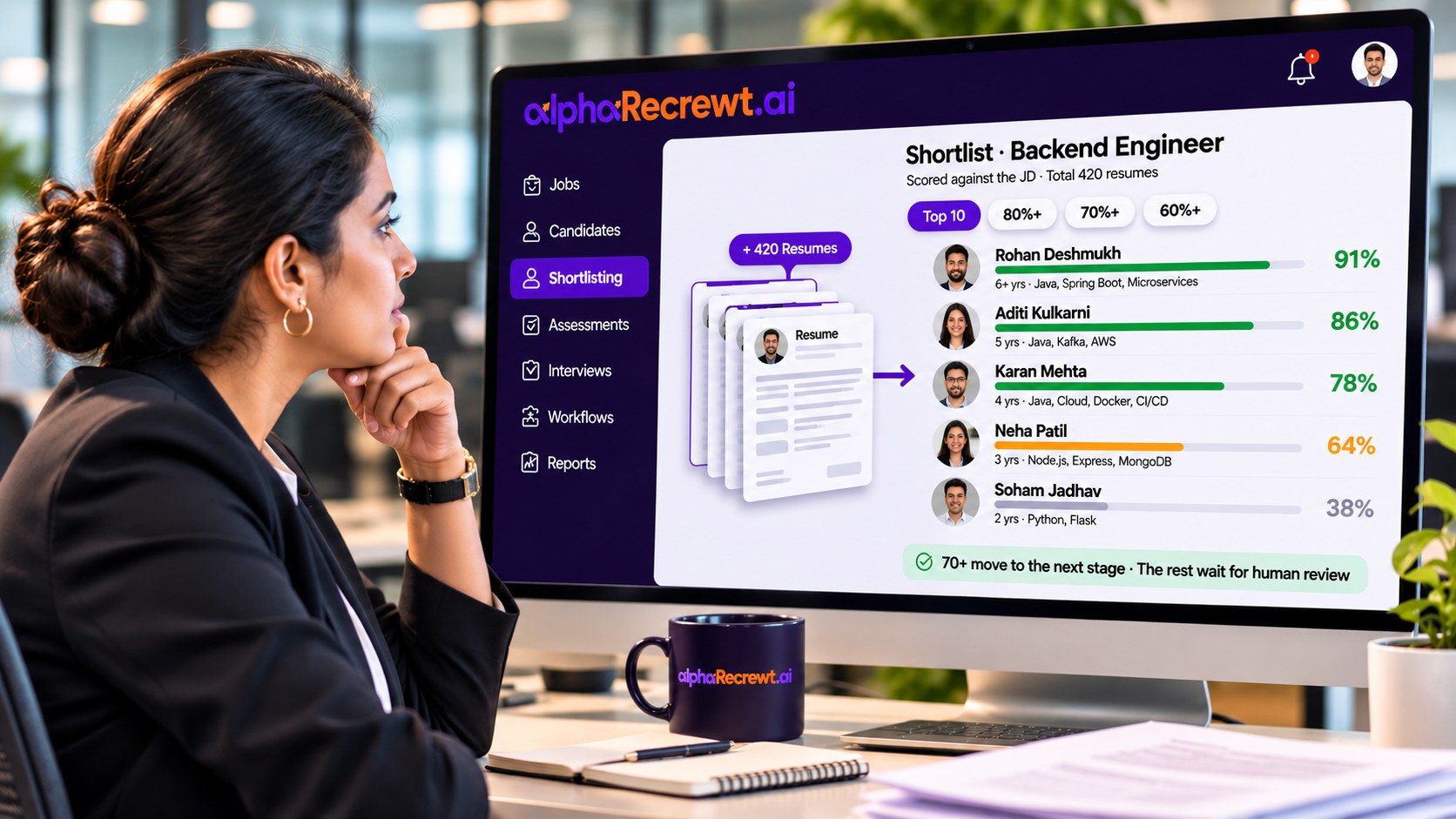
The job went live on Monday. By Wednesday there were 200 CVs in the inbox, the hiring manager was asking for a shortlist, and the recruiter had opened 40 of them. The other 160 got a few seconds each — if they got opened at all.
That is how most first-round screening works: not badly, just too fast to be fair. The candidate who described their work honestly but plainly loses to the one who stacked the right keywords. And nobody can say afterwards why one was called and the other was not.
“The problem is not reading CVs. It is reading the hundred-and-fiftieth one as carefully as the first.”
How it works
Bulk CV shortlisting sits on the job itself. You upload the CVs you already have — from email, a job board export or a referral drive — and AlphaRecrewt takes it from there. Processing runs on the server, so you can close the panel and come back to a scored list.
Drop the pile
Upload PDF, DOC or DOCX files — or one ZIP — up to 50 CVs per batch, straight onto the job.
Parse, merge, notify
Each CV becomes a candidate profile. Existing candidates are matched by email, and every new applicant is told they are in the process.
Score against the JD
Every CV gets a 0–100 fit score with a short written reason that points to evidence in the CV.
Move the right people
Candidates at or above your cutoff move to the next stage automatically. Everyone else waits for a human.
A score you can argue with
A number on its own is just another black box. So every score comes with a short reason, and the scoring is told to stick to what the CV actually shows: no assuming skills that are not written down, and thin evidence means a low score — however many keywords are listed.
Sample scores · illustrative, backend engineer JD
Built and scaled payment APIs in Go for 3 years; cites Postgres query tuning and on-call ownership. Matches core backend requirements.
Strong Java and Spring evidence across two roles. Cloud is listed as a skill but no project shows it, so it is not counted as proven.
Mostly frontend work. One internal tool mentions a REST API, but there is little evidence for the backend depth the JD asks for.
CV lists the required keywords but gives no project or role where they were used. Thin evidence, low score.
Manual first pass vs. bulk shortlisting
| Manual first pass | Bulk CV shortlisting | |
|---|---|---|
| First look at 200 CVs | Someone opens every PDF | Scores and reasons ready to sort |
| Consistency | Depends on who reads, and when | Every CV read against the same JD |
| Why someone was shortlisted | In the recruiter’s head | Written next to the score |
| Candidate communication | Often nothing until rejection | Automatic “you’re being considered” email |
| Who decides | The recruiter | Still the recruiter — with a ranked list |
You stay in control
Set the bar: each job’s screening stage has its own cutoff score (70 unless you change it).
Add hard requirements: graduation year and minimum 10th, 12th, graduation or PG marks — applied only when the CV actually states them.
Sort the pile your way: one click for the Top 10, 80%+, 70%+ or 60%+ in the candidate list.
Overrule the score: anyone below the cutoff stays visible for review, and an admin can move them forward.
Pay per CV scored: each scored CV uses one screening credit; if credits run out, the run pauses instead of failing.
What it will not do
Honest limits matter in hiring. Scanned image-only or password-protected PDFs cannot be read, and a CV without an email address cannot become a candidate — both are listed with a plain reason so you can follow up. The score is a first-pass ranking to help a person decide faster; it does not replace the interview, and nobody below the cutoff is rejected automatically.
Where it fits
Shortlisting is the first stage of the hiring workflow, so the candidates who pass flow straight into whatever comes next: an online assessment, the AI Interview Bot or a human interview. The 200-CV week becomes a list of the people worth meeting — with the reason written next to each name. ■
Book a shortlisting demo